
Why Orange County’s Housing Market Isn’t Crashing: 2008 vs. Today
Worried about an Orange County housing crash like 2008?
Discover why today’s low inventory, high equity, and strict lending rules create a stable market.

Is History Repeating Itself in Orange County Real Estate?
If you listen to the news or scroll through social media, you have likely heard chatter about mortgage rates climbing, sales slowing down, and home prices feeling stretched. For anyone who lived through or remembers the Great Recession of 2008, these headlines bring up familiar anxiety.
It is natural to wonder whether we are watching a crash unfold in slow motion. When mortgage rates jump from around 6% to 7.5% in a matter of weeks and buyer demand drops, it feels like the early warning signs of a downturn.
However, feeling like a crash is coming and having the financial underlying conditions to cause one are two completely different things. The data shows that today’s Orange County housing market is built on a fundamentally different structural foundation than the market of 2008.
The 3 Ingredients Needed for a Real Estate Crash
To understand why a crash is not looming, it helps to look at what actually causes home values to plunge. Historically, a real estate market crash requires three specific conditions occurring simultaneously:
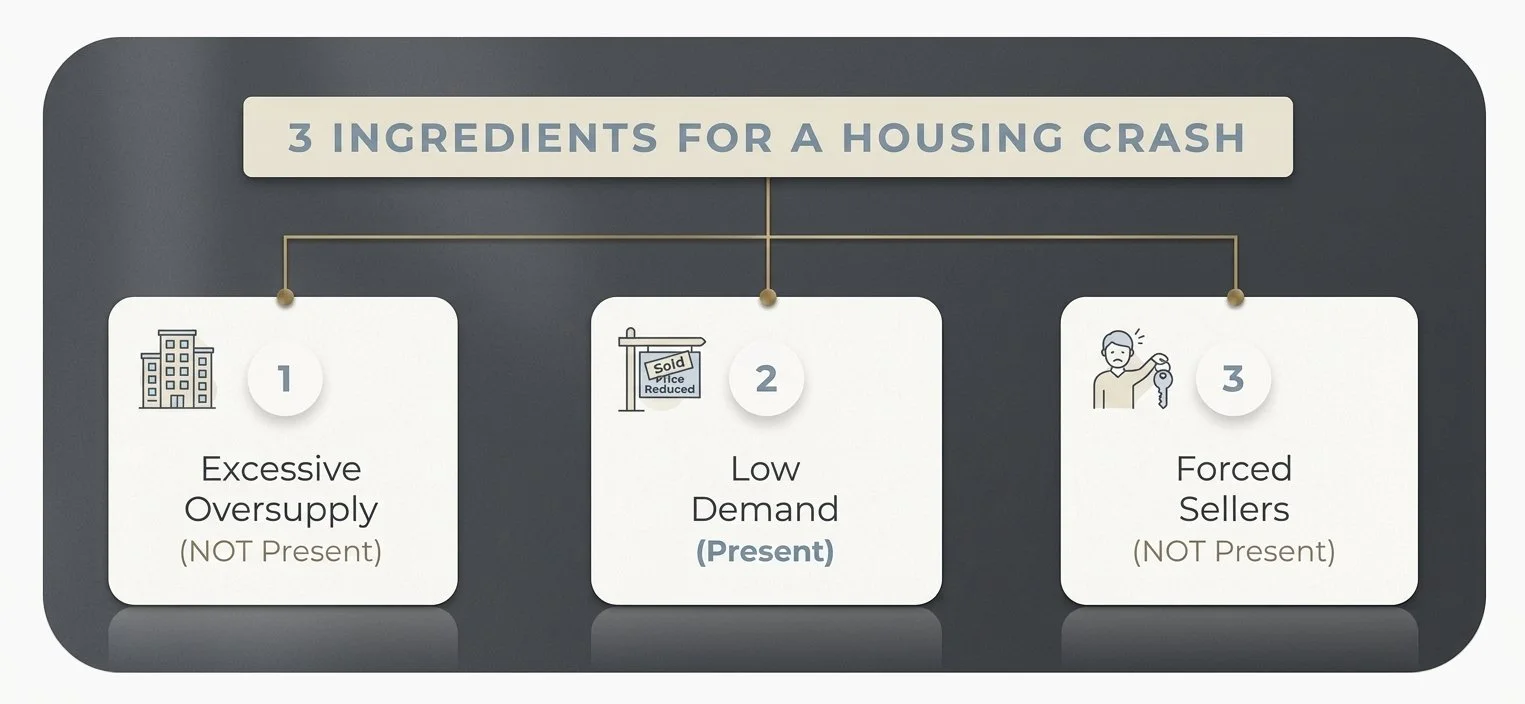
Excessive Oversupply: A massive glut of homes for sale that far exceeds buyer demand.
Low Demand: A drop-off in buyer activity.
Forced Sellers: A wave of homeowners who are legally or financially compelled to sell, regardless of price (such as through foreclosures, short sales, or rate resets).
Right now in Orange County, only one of these three conditions exists: low demand.
Because mortgage rates surged to 7.5%, pending sales slowed down by 8% over two weeks to 1,349 pending transactions—the lowest September demand reading since 2007. But without oversupply and forced sellers, low demand leads to a slower market pace, not a price collapse.
2008 vs. Today: Comparing the Numbers
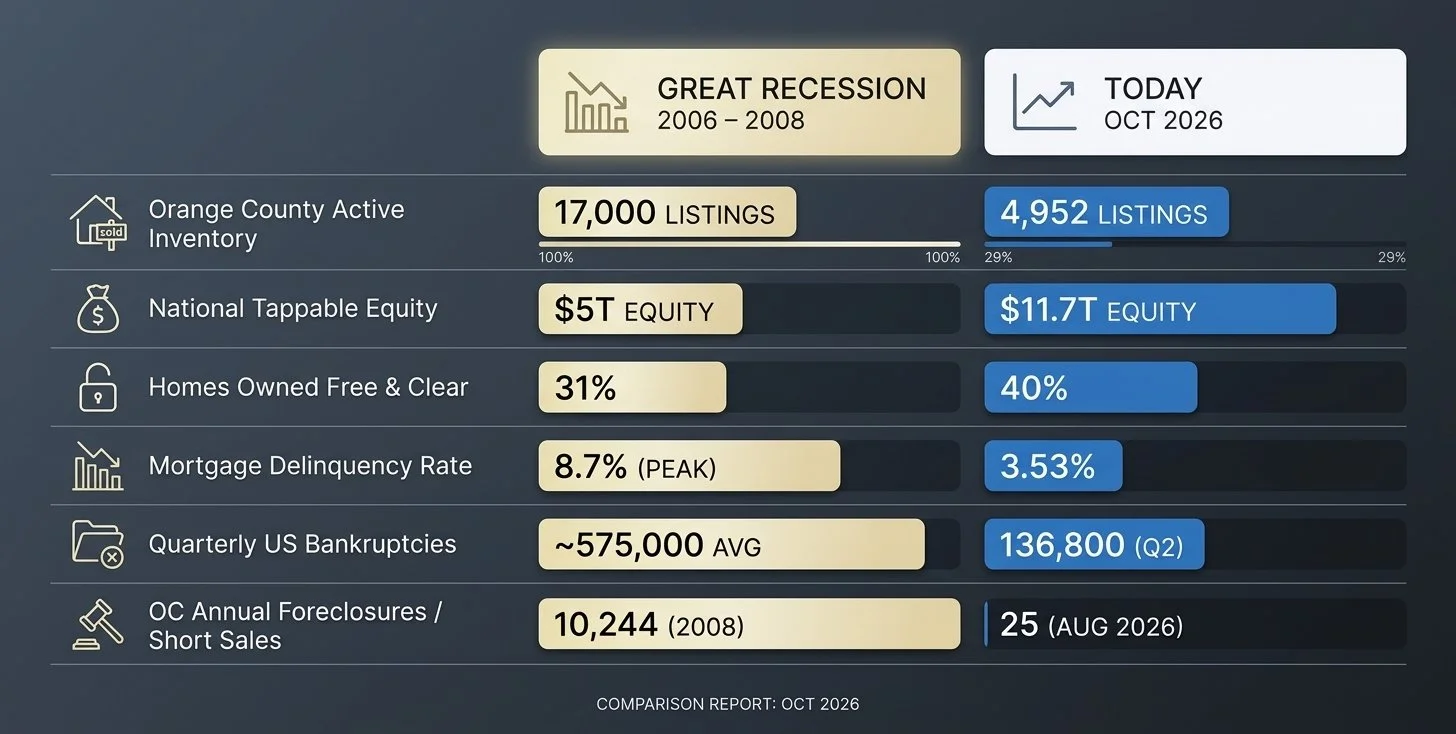
Comparing today’s metrics directly with the peak of the Great Recession highlights how different the market conditions are today.
Supply is Kept Low by the "Hunker Down" Effect
In 2006 and 2007, Orange County had between 16,000 and 18,000 homes available for purchase, more than three times today’s active listing count of 4,952.
Today’s supply remains constrained because current homeowners are holding onto locked-in low fixed rates from previous years. Between January and August 2026, 21,374 homes were listed in Orange County—27% fewer than the pre-COVID average. Homeowners are simply choosing to stay put rather than trade a 3% mortgage for a 7.5% loan.
Strict Lending and Solid Equity Prevent Forced Selling
The 2008 crash was driven by predatory lending practices: zero-down-payment loans, subprime mortgages, teaser-rate ARMs, and sub-680 FICO requirements. When rates reset, millions of borrowers defaulted because they had no equity in their homes. In 2006, 22% of homes had negative equity.
Today, the lending landscape is strictly regulated. Borrowers are vetted with higher average credit scores and substantial down payments. Nationally, American homeowners hold $11.7 trillion in tappable equity, and 40% of homeowners own their properties outright with no mortgage at all. Only 2% of homes currently have negative equity.
Distressed sales (foreclosures and short sales) accounted for over 10,000 sales annually in Orange County during the crash. Year-to-date in 2026, only 25 distressed sales have closed across the entire county. Today, 99.72% of all sellers are equity sellers who can choose when to list and sell.
What This Means for Buyers and Sellers Today
Understanding this data shifts strategy for both buyers and sellers in the current autumn market:
For Buyers: You do not need to wait for a crash that lacks the supply to happen. Current high mortgage rates have reduced competition, expanding Expected Market Time to 110 days. This gives you room to negotiate prices, ask for seller concessions, or secure rate buy-downs without facing high-stress bidding wars.
For Sellers: While a crash is not coming, pricing strategy remains critical. With demand dropping 8% and mortgage rates hovering at 7.5%, buyers are price-sensitive. Homes that are overpriced face extended days on market, requiring strategic adjustments before the slower winter holiday season.